A love spell to rekindle passion and romance is one of the gentler requests in this field. The person asking usually isn’t trying to win back someone who left. They’re trying to bring warmth back to a relationship that’s still intact but has gone flat: fewer touches, fewer jokes, less curiosity, a partner who feels more like a flatmate. It’s a tender thing to want, and it deserves a straight answer.
The straight answer is that a ritual can’t switch desire on in another person. It can, though, help you slow down, set an intention and create a shared moment that feels different from an ordinary evening, and those things matter more than they sound. Passion in a long relationship almost never returns through one grand act. It returns through attention, play, novelty, safety and a bit of patience, and a ritual can give that effort a shape and a starting point.
This guide is for readers in Australia first and Europe second. It explains why passion fades, what a love spell to rekindle passion and romance can and can’t do, how to talk about it without causing a fight, a two-week plan that works with or without a ritual, and when to bring in a GP or counsellor. Few explained why desire dips, which is where most of the useful answers are.
Key takeaways
- Passion fades mainly through routine, stress, tiredness and unresolved resentment. All of those can be worked on.
- A ritual can set intention and mark a fresh start. It can’t create desire or remove the need for honest conversation.
- Novelty, unhurried time, affection without pressure and feeling appreciated do the most to bring closeness back.
- Persistent low desire, pain or a sudden change can have medical or emotional causes. Talk to your GP or a counsellor.

Why passion fades in a relationship
Passion usually dims for ordinary reasons. Early in a relationship, everything is new and your attention is intense. Over time, novelty drops, routines settle in and the brain stops treating your partner as a puzzle. That’s natural, and it doesn’t mean the relationship has gone wrong. It means it needs different fuel from the start-up phase. For marriages close to ending, see the stop divorce spell consultation.
Life piles on. Work pressure, money worries, young children, caring for parents and poor sleep all take energy that romance runs on. Health changes, hormonal shifts, some medications and low mood can affect desire. Resentment does too: if you feel unappreciated or unheard, closeness becomes hard to feel. Some couples drift because they stop making time for each other, and by the time they notice, the habit of distance is established.
It’s worth naming which of these applies to you. If the cause is tiredness and routine, novelty and time will help. If it’s resentment, that needs repair first. If it’s a health or emotional factor, seeing a professional is sensible. A ritual with no understanding of the cause is a guess, and a good guide begins with the cause.
Desire doesn’t always arrive first
Many people assume that desire should appear out of the blue, and that if it doesn’t, something is broken. The sex educator and author Emily Nagoski, among others, has written about a different pattern in which desire often responds to closeness and context instead of arriving spontaneously. In that pattern, a person may not feel interested until affection, privacy, relaxation and a sense of connection are in place, and then interest follows.
That matters because it changes the approach. If you’re waiting for the feeling before making time together, you may wait a long time. If you create the conditions first, such as unhurried time, a relaxed mood, affection without pressure and a sense of being wanted, desire often has room to appear. This isn’t a guarantee, and everyone differs. But it shifts the question from “why don’t I feel it?” to “what helps me feel close?”, which is much more answerable.
What a love spell to rekindle passion and romance can and can’t do
A ritual is a focused act of intention. For romance, it often involves candles, flowers, herbs or oils chosen for traditional meanings, and a clear statement of what you’re asking for, such as warmth, playfulness and closeness. It may be done alone or together.
What it can do is slow you down. Setting aside time, lighting a candle and naming what you hope for is, in itself, a break from the ordinary evening of screens and logistics. It can calm anxiety about the relationship and help you approach your partner with warmth rather than pressure. Research on ritual gives a hint at why: Norton and Gino, in a 2014 paper in the Journal of Experimental Psychology, found that performing rituals helped people feel more in control and less anxious after a loss. That doesn’t prove a ritual changes another person’s desire. It does suggest it can steady the person who performs it.
What it can’t do is create attraction, override someone’s wishes or substitute for talking. Be wary of any spell that claims to “make him or her desire you”, to work without your partner’s knowledge or to guarantee passion within days. Passion that’s produced by pressure isn’t passion, and rituals aimed at another person without their consent raise ethical problems covered below. The guide to rekindle lost love spells explains more about what this kind of work aims at.
How to talk about it without starting a fight
This topic is sensitive, and the way you open it matters. Choose a calm, private moment, not in bed and not after an argument. Start with yourself: “I’ve been missing us lately, and I’d like to feel closer. Can we talk about it?” That invites rather than accuses. “You never want me” puts your partner on the defensive, and defensiveness ends the conversation.
Ask open questions and listen. What does your partner miss? What would help them feel closer? What gets in the way? Expect to hear things that sting, such as feeling criticised or tired or pressured, and resist the urge to respond with your own grievances. Thank them for being honest. Then agree on one or two small experiments you can both try over the next couple of weeks, rather than a large overhaul.
If the conversation is too hard to start alone, a counsellor can help, and there’s no shame in it. Many couples find that naming the problem out loud, with support, is a relief in itself.
Romance in small daily ways
Romance isn’t only candlelit dinners. It lives in small gestures repeated often. A message in the middle of the day that says you’re thinking of them. A coffee made without being asked. A hug that lasts a few seconds longer than a greeting. A compliment that’s specific and sincere. A few minutes of real attention when they walk in the door, before the evening rush starts.
Remember what you used to do early on, and bring some of it back: the nicknames, the in-jokes, the playlists, the way you teased each other. Ask questions you haven’t asked in years, such as what they’re looking forward to, what’s worrying them and what they’d do if money weren’t an issue. Curiosity is one of the most underrated forms of romance, because it tells your partner they’re still interesting to you.
Novelty and shared experiences
Doing something new together is one of the best-supported ways to bring back closeness. Psychologist Arthur Aron and colleagues, in a 2000 study in the Journal of Personality and Social Psychology, found that couples who shared novel and mildly exciting activities reported better relationship quality. The activity doesn’t need to be dramatic. It needs to be new enough that you’re paying attention to each other rather than running on autopilot.
Try a dance class, a new hiking trail, a day trip to a town you’ve never visited, a cooking class, a night swim, a stargazing evening away from city lights or a market you haven’t explored. In Australia, there’s no shortage of coastlines, bush walks, wineries and small towns within a day’s drive of most cities. Take turns choosing, so both of you have a say. The aim is to be playful together and to see each other in a slightly different light.
Touch without pressure
When desire has dipped, touch is often the first thing to vanish, and pressure makes things worse. If every hug risks turning into a request, both people learn to avoid hugs. A useful approach, borrowed from couple therapy, is to have regular physical closeness with no expectation of sex. That might be a cuddle on the couch, a back rub, holding hands on a walk, or lying together and talking.
The point is to rebuild comfort with touch as connection rather than negotiation. Agree in advance that these moments are just for closeness, and stick to that. Over a few weeks, many couples notice that affection feels easier and more natural, which can open the way to more. If either of you finds this hard, or if there are past difficulties around intimacy, a therapist can help you go at a pace that feels safe.
Health, stress and life factors worth checking
Sometimes low desire has a physical or emotional cause, and it’s worth ruling those out. Tiredness, poor sleep, high stress, low mood, anxiety, hormonal changes including those around menopause, thyroid problems, some medications and alcohol can all affect desire. Pain during intimacy, or a sudden change in desire that worries you, is a good reason to see a doctor.
Talk to your GP. They can check for physical causes, discuss medications and refer you to a counsellor or sex therapist if that would help. Being open about it, with your partner and your doctor, reduces the sense of shame, and it’s often a relief to find that there’s a practical explanation. A ritual can sit alongside all of this, but it shouldn’t replace medical advice.
A romantic evening ritual you can do at home
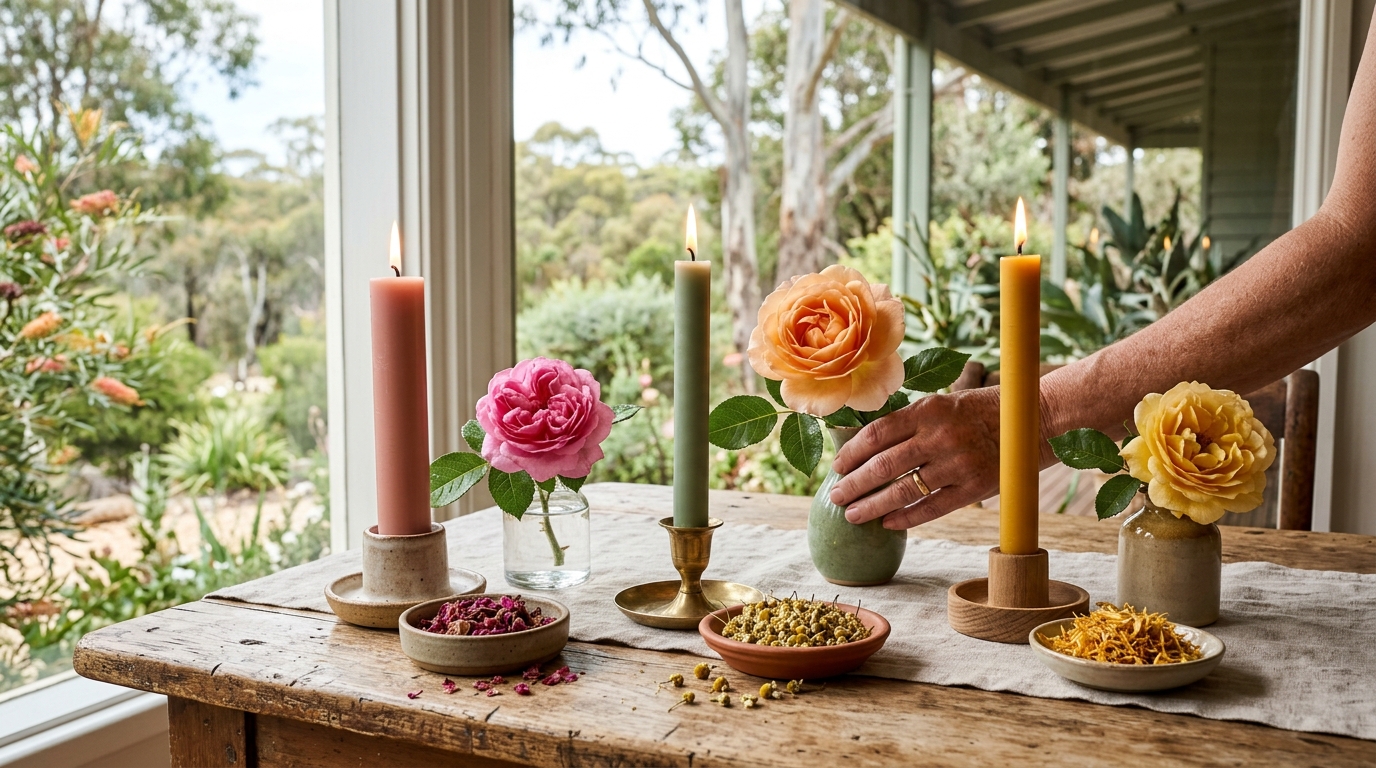
If you like the idea of a shared ritual, here’s a simple one. Choose an evening when you won’t be rushed. Set the table or a corner of the room with a couple of candles and something that means something to you both, such as flowers, a photo or a keepsake from a trip. Put phones in another room. Cook or order a meal you both enjoy.
When you sit down, light the candles together. Each say, out loud, one thing you love about the other, one good memory you share and one thing you’d like more of in the year ahead. Listen without commenting. Let the candles burn while you eat and talk. At the end, say a simple intention together, for example, “May we keep choosing each other and making time for this.” You can add music, a slow dance in the kitchen or a walk afterwards.
None of this needs a practitioner. It works because it’s specific, shared and unhurried. If you’d like to see candle colours and their traditional meanings, the guide to marriage spell candles covers them, and the page on love spells for married couples describes renewal rituals for longer marriages.
A gentle two-week plan
A plan helps turn good intentions into habits. This one is deliberately light.
In the first three days, focus on affection and attention. Give a sincere compliment each day, a longer hug and a few minutes of real conversation. On days four to six, bring back something you used to do, such as a playlist, a walk, an old joke or a shared show. On day seven, plan a small shared experience for the weekend, something new but easy.
In the second week, add the conversation: choose a calm moment and talk about what each of you misses and wants, using the approach above. Try the no-pressure touch for ten minutes on a few evenings. Hold the romantic evening ritual on the weekend. At the end of the fortnight, check in: what felt good, what felt awkward, what would you like to keep? Adjust and continue. If nothing shifts or one of you feels worse, that’s useful information, and it may be time to bring in a counsellor.
When you are both exhausted
For couples with young children, a demanding job or a caring role, the honest obstacle to romance is often plain tiredness. When both people are running on too little sleep, the idea of a candlelit evening can feel like another task. It helps to lower the bar. Ten minutes of undistracted conversation after the children are asleep, a shared cup of tea on the back step or a slow hug in the kitchen counts. Protect those small moments the way you’d protect an appointment.
It also helps to divide the load so rest is possible. If one of you does the night shifts every time or carries the household planning, resentment and depletion will eat into any romance. Agree who takes which nights, swap a morning now and then so each of you can sleep in, and ask family or friends for practical help. A rested couple has far more energy for affection than one that’s running on empty, and no ritual replaces that.
When resentment blocks closeness
Passion and unresolved resentment rarely coexist. If one of you feels chronically unappreciated, unheard or unfairly burdened, closeness is hard, and no ritual will overcome that. Sometimes the best thing for romance is to repair the hurt first.
That might mean an honest conversation about fairness in the household, an apology that’s long overdue or a counsellor to help you both say things that have been left unsaid. It might mean changing habits such as criticism, sarcasm or withdrawing. Couples often find that once the resentment eases, warmth returns more easily than expected. Repair comes first, and romance builds on it.
When one of you wants more than the other
Mismatched desire is very common, and it’s a source of pain on both sides. The person who wants more may feel rejected, and the person who wants less may feel pressured and guilty. Neither is wrong. The aim is to find a pattern that respects both, rather than to decide who’s right.
Talk about it without blame. The person with higher desire can share how rejection feels without demanding change. The person with lower desire can explain what helps and what shuts them down. Agree on ways of staying connected that don’t depend on sex, and on times and conditions that feel easier. A counsellor or sex therapist can help, and it’s a far better path than avoidance or resentment. A love spell isn’t a fix for mismatched desire, and any seller who says it is, is overpromising.
What a consultation with Baba Ali involves
If you’d like a spiritual element, you start by sending your story through the secure form on the contact page. Baba Ali reviews it and talks with you about your relationship and what you hope for. He advises whether spiritual work is appropriate and what it would include. The stages are set out on the how it works page: consultation, preparation of ritual materials, the ritual itself, and updates through a private client portal.
You should be able to ask what each stage involves and what it costs, and you should be told that the outcome can’t be guaranteed. Anything intimate that you share should be treated privately. For how remote sessions work for clients across the country, see the page on a love spell caster in Australia.
Counselling and sex therapy in Australia
Couples counselling is a good place to talk about intimacy, and it doesn’t conflict with spiritual practice. Relationships Australia (1300 364 277) offers counselling and family services, and the Family Relationship Advice Line (1800 050 321) provides free information and referrals. Your GP can refer you to a counsellor or a qualified sex therapist if that’s what you need.
In a first session, expect to be asked what brought you in and what each of you wants. A good therapist won’t push you to do or disclose anything you’re not comfortable with. They’ll help you talk about what’s hard in a way that doesn’t blame either of you, and they’ll often suggest small practical steps. If your partner isn’t ready to attend, going alone is a legitimate start.
Mistakes that kill romance faster
A few habits reliably work against you. Pressure for affection or sex, even when subtle, makes your partner withdraw. Criticising their body, desire or performance causes hurt that lingers. Comparing your relationship to others, or to a past one, breeds resentment. Keeping a ritual secret that targets your partner’s feelings crosses a line.
So does expecting one grand gesture to fix months of distance, using sex or affection as a bargaining chip, and letting all the romance depend on one person. The alternative is shared effort, patience and a willingness to talk about awkward things kindly.
Scam warning signs
Because the subject is personal, people are less likely to ask for help and more likely to be taken advantage of. Be wary of guaranteed results, fixed timeframes, large upfront payments, repeated requests for more money to “strengthen” a spell, claims of a curse or blocked energy in your relationship and threats of bad luck if you stop. Be wary too of requests for intimate photos or private details that aren’t needed. Being blocked changes the plan, as our page on my ex blocked me explains.
In Australia, Scamwatch, run by the ACCC, publishes current scam information and takes reports, and your bank can sometimes help if you contact them fast. Our guide to spell caster scams in Australia lists the red flags. Before you pay anyone, write down what you’ve been promised, what it costs and what happens if nothing changes.
If you live in the UK or elsewhere in Europe
The same advice applies. In the UK, Relate offers couples counselling and sex therapy, and your GP can refer you to local services. Across Europe, many countries have public or low-cost relationship and sexual health services, so ask your GP or local health service what’s available. Remote consultations work across time zones, which suits clients in Europe as much as those in Australia.
Cultural attitudes to talking about intimacy vary a great deal, and a consultation or counsellor who takes your background into account will be more useful than a script written for someone else. Wherever you live, privacy and respect are the baseline, and you should never feel pressured to share more than you want to.
Keeping romance alive once it returns
If warmth returns, protect it. Keep the small daily gestures going. Keep the regular date, even when life is busy. Try something new every month or two. Keep talking about what’s working and what isn’t, and don’t let a small hurt sit for weeks. Appreciation out loud, often, in specific words, is one of the cheapest and most effective habits you can keep.
Expect fluctuation. Every relationship has seasons, and closeness comes and goes with stress, health and time. What matters is that you both know how to find your way back: a phrase that means “I’m feeling distant, can we reconnect?”, a standing date, a weekend away each year. Couples who do this tend to ride out the dips without the drift turning into distance.

Frequently asked questions
Can a love spell to rekindle passion and romance really work?
A ritual can’t create desire in another person. It can help you feel calmer and more intentional, and it can give a couple a shared moment that feels different from an ordinary evening. Results depend on both people and on what changes in daily life.
How long does it take to bring passion back?
There’s no fixed timeline. Some couples notice warmer affection within a couple of weeks of small changes. Others take months, sometimes with counselling. Be wary of anyone promising a date.
Is it okay to do a passion spell without my partner knowing?
A private ritual for your own calm and intention is one thing. A ritual aimed at your partner’s feelings without their knowledge is another, and it raises ethical issues and can damage trust if discovered. The best approach is to do it together or at least be willing to tell your partner.
What if my partner has no interest in romance at all?
Ask calmly what’s going on and listen. Low interest can have medical, emotional or relationship causes. Suggest seeing a GP or counsellor together or separately. If your partner isn’t willing to engage, that’s important information about what you can realistically change.
Do I need crystals, herbs or oils?
No. Traditional rituals often use them for their symbolic meaning, and some people like the sensory side, but nothing about a meaningful evening requires special items. Candles, flowers and sincere words are enough.
Does a love spell to rekindle passion and romance work for long-distance couples?
Distance doesn’t change how a ritual is understood, and consultations are remote anyway. It does change the relationship, so plan regular calls, visits and shared activities online, and be honest about how hard it is to rebuild physical closeness across a screen.
Could low desire be a medical issue?
It can be. Stress, sleep, hormones, medications and mood all play a part. If the change is sudden, persistent or accompanied by pain, see your GP.
Should we try counselling instead?
Counselling and sex therapy have a practical evidence base, and they don’t conflict with spiritual practice. Many couples use both. If you’re stuck or avoiding the subject, a therapist can make the conversation easier.
Your next step
If you’d like to talk through your relationship in private, you can start a confidential consultation through the contact page. You can also browse the other services, or read how the site writes and checks its guides in the editorial standards. A love spell to rekindle passion and romance is best understood as a way to set an intention and start a conversation, not a guarantee. If you’re struggling, call Lifeline on 13 11 14 in Australia or Samaritans on 116 123 in the UK.