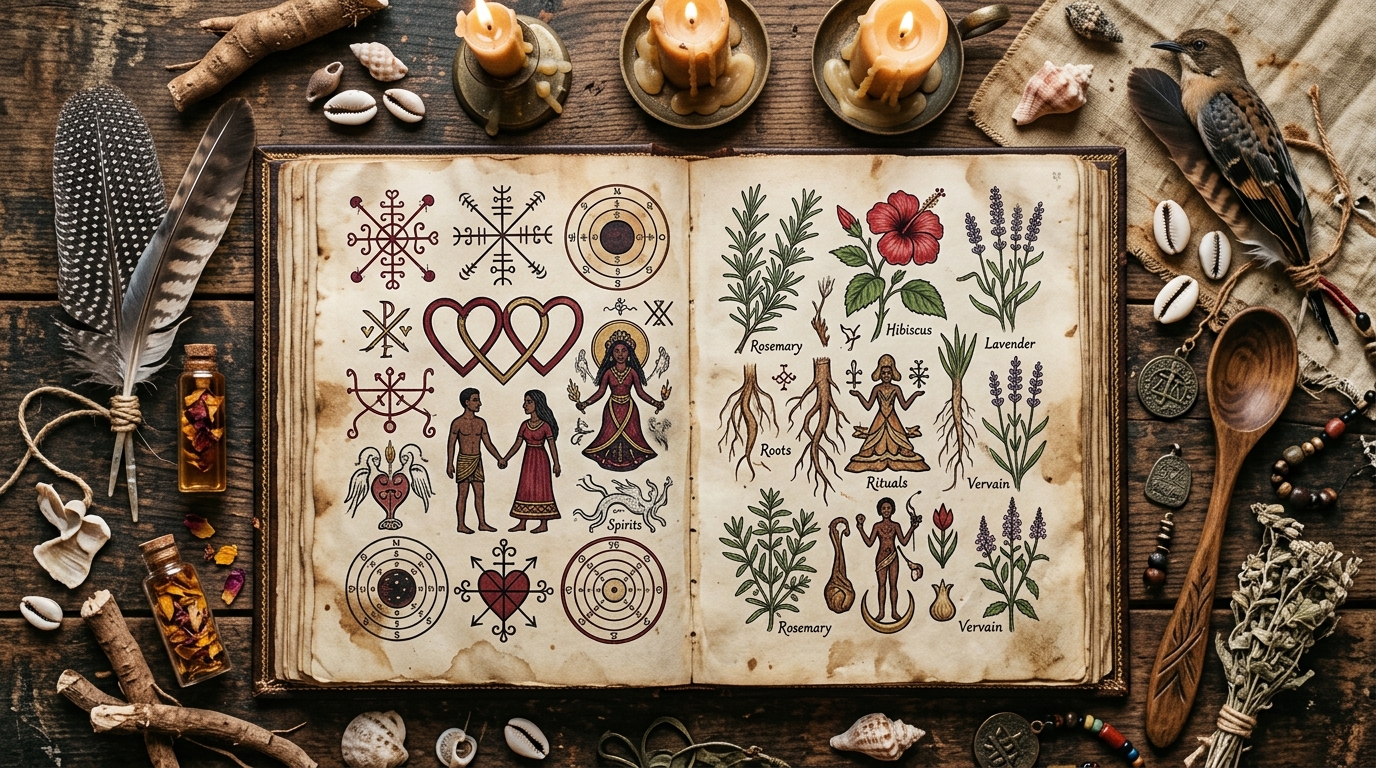
Authentic Vodou love spell ingredients carry deep spiritual significance — from sacred herbs and candles to ritual oils and symbolic objects used in traditional West African magic.
Most Powerful Love Spell Ingredients in Vodou Practice
The Origins of Vodou — The Foundation
Vodou as a formal spiritual system emerged among the Fon and Ewe peoples of the Kingdom of Dahomey — present-day Benin — developing over millennia into one of the world’s most sophisticated spiritual traditions. Archaeological and historical evidence suggests that the core practices of Dahomean Vodou have roots extending back at least 3,000 years, making it among the oldest continuous spiritual traditions still actively practiced today.
Unlike many spiritual traditions that developed as philosophical or theological systems, Dahomean Vodou emerged primarily as a practical healing and community-support system — a set of technologies for working with the spiritual forces that governed human life in ways that produced observable, practical results in the community.
Love Magic in Ancient Dahomean Tradition
Love and relationship magic holds a specific, honored place in Dahomean spiritual practice. In the Dahomean worldview, human partnership is not merely social — it is a fundamental spiritual reality that the Lwas take active interest in. The union of two compatible souls was considered a matter of spiritual significance, and the disruption of such unions a spiritual wound requiring spiritual healing.
Ancient Dahomean love magic served several distinct functions that persist in my practice today:
- Attraction work: Helping individuals broadcast their spiritual love frequency to attract compatible partners.
- Union strengthening: Rituals performed at marriage to spiritually seal and protect the union.
- Reunion facilitation: Bringing separated partners back together by working with the spiritual bond that persisted after physical separation.
- Protection work: Protecting established love relationships from spiritual interference by jealous parties.
- Healing work: Addressing the spiritual wounds created by betrayal, infidelity, or profound conflict within relationships.
Each of these functions was assigned to specific Lwas and performed through specific ritual protocols that were transmitted across generations within practitioner families and initiated communities.
The Role of Erzulie in Love Tradition
No understanding of Vodou love magic is complete without understanding Erzulie — the most complex and beloved of all the Lwas who govern love. Erzulie is not a single figure but a family of Lwas, each governing different aspects of love and feminine power:
Erzulie Freda: The Lwa of romantic love, beauty, and attraction. Associated with the color gold and pink, with jewelry and perfume, with the sweetness of newly discovered love. She is invoked for attraction work and in the early stages of reunion rituals.
Erzulie Dantor: The fierce, protective aspect of love — passionate, devoted, fiercely maternal. She governs long-term commitment, the protection of families, and the kind of love that endures through hardship. She is invoked for marriage strengthening and protection work.
La Sirène: The Lwa of the ocean and deep desires — governing the unconscious emotional depths and the magnetic pull of irresistible attraction. Invoked in obsession and passion work.
How African Love Magic Traveled to the Americas
The transatlantic slave trade — one of history’s greatest crimes — also became the vehicle through which Dahomean spiritual practice reached the Americas. Enslaved Dahomean practitioners carried their spiritual knowledge with them across the ocean, preserving it in the only way possible under conditions of brutal oppression: through memory, oral transmission, and creative adaptation.
In Haiti, enslaved Dahomeans merged their tradition with elements of French Catholicism — not out of conversion, but as a protective strategy. By associating Lwas with Catholic saints, practitioners could continue their traditions under the noses of colonial authorities who monitored and often prohibited African spiritual practice. This syncretism produced Haitian Vodou — a distinct but deeply related tradition that preserved the core Dahomean spiritual framework in Caribbean form.
In Louisiana, similar processes produced Louisiana Voodoo — shaped by the specific mix of African, French, Spanish, and Native American influences that characterized the colony. Marie Laveau, the legendary “Voodoo Queen of New Orleans” (1801–1881), represents perhaps the most famous American figure in this tradition’s history.
Modern Vodou — How the Tradition Survives and Adapts
Today, authentic Vodou practice continues in West Africa, Haiti, the United States, Brazil, Cuba, the Dominican Republic, and throughout the African diaspora. The tradition is remarkably resilient — having survived colonialism, slavery, religious persecution, and sustained cultural attack.
In the United States, Vodou practitioners like myself serve a diverse community of clients — bringing the accumulated wisdom of this ancient tradition to bear on the very human challenges of love, relationship, and connection that have always been at the tradition’s heart.
What I do is not divorced from this history — it is its continuation. The same Lwas. The same protocols. The same commitment to genuine healing. Adapted for the American context, but rooted in a tradition 3,000 years deep.
Speak Directly with Baba Ali — Free Consultation
To experience authentic West African Vodou love practice for yourself, contact Baba Ali for a free consultation.
Get Your Free Consultation →📞 (210) 651-2737 | 💬 WhatsApp | Available 24/7
For relationship advice and support, Psychology Today’s Relationships section offers expert guidance from licensed therapists worldwide.